|
4-Note Voicings
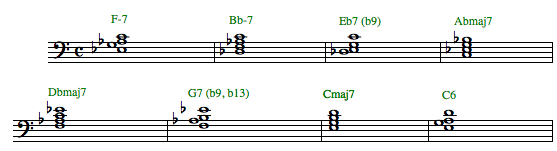
Since chords often move in 4ths and 5ths, alternating between the two types of voicings will often result in smooth, subtle voice leading as seen here in the first 8 bars of the song, "All the Things You Are":
The first chord, F-7, is a "B" voicing and the next chord, Bb-7, is an "A" voicing and this pattern keeps alternating. Smooth voicing leading is nice, but also it can be artisticly pleasing to travel around more playing consecutive "A" and "B" voicings. In the previous example, the Dbmaj7 chord is voiced as a consecutive "A" voicing because as the chords move lower they begin enter "muddy" territory playing 4 notes so close. In addition to these two voicings, there are other ways to play 4-note chords leaving the 3rd or 7th out. The final chord in the example is 3,5,6,9 simply because it sounds nice to keep the harmonic rhythm of whole notes in a downward motion. The use of chord tensions is a great way to add color to the sound of your voicings. This is especially true for dominant V7 chords because the tensions can be altered or left natural in varying combinations. Alternatively, the use of roots and 5ths can make these voicings sound simpler and more traditional. 4-note voicings are a great choice when you want fuller chords rather than simple shell voicings. Proceed to two handed voicings or to The Jazz Resource Homepage |